NYC PLAN Rally Transcript
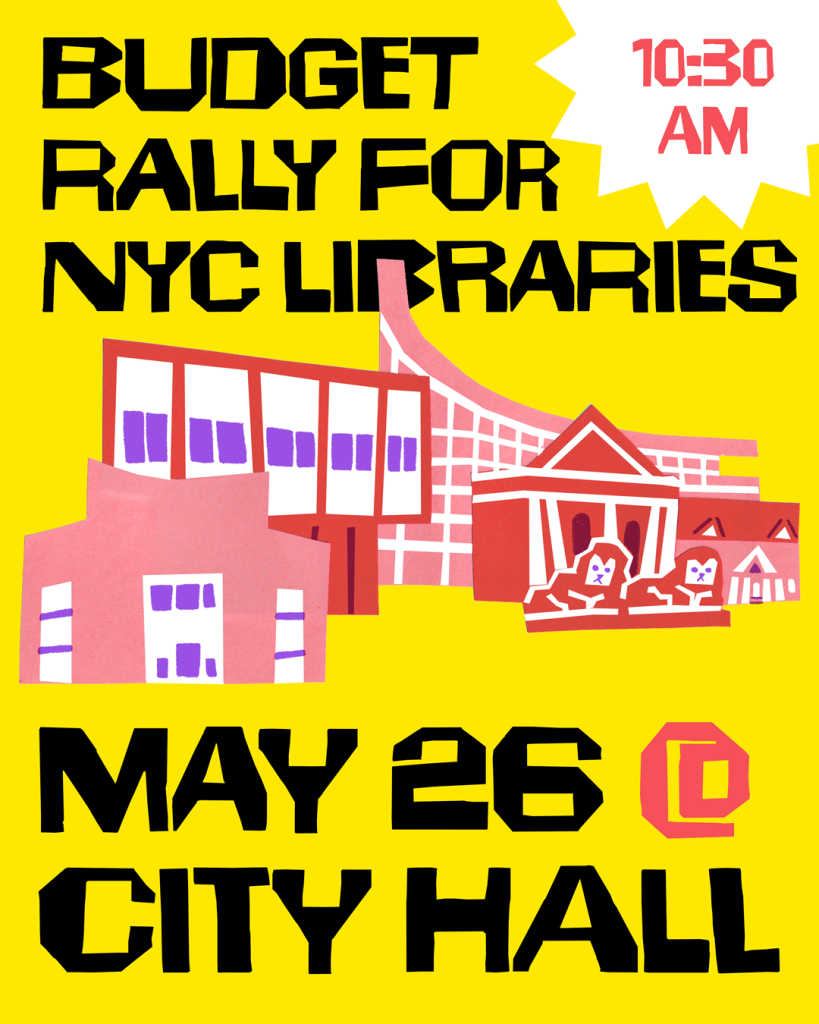
On Monday, May 26, 2026, NYC PLAN held a rally featuring library advocates, elected officials, and youth to demand 0.5% of the city budget for our libraries. The transcript of the rally is included below:
Dylan Flesch: Thank you so much, everyone, for being here for libraries today. We are NYC PLAN, the Public Library Action Network.
[cheers and applause]
Dylan: We’re here demanding 0.5% for our public libraries.
Crowd: Yes.
Dylan: Yes, a demand that Mayor Mamdani agreed to, and reiterated multiple times, and now has broken his promise on. So we are fighting and pushing the city council to fight for him to keep that promise, and fight for more for our library. So thank you all for being here. Our first speaker today is Council Member Christopher Marte, who I’ll let you take it away.
Christopher Marte: Good morning everyone. When I say what do we want you say 0.5%, all right. What do we want?
Crowd: 0.5%.
Christopher: What do we want?
Crowd: 0.5%.
Christopher: What do we want?
Crowd: 0.5%.
Christopher: It almost sounds ridiculous that we’re asking for 0.5%, but that’s why we’re here. You know, a promise is a promise. Of course we thank Mayor Mamdani for restoring the funding for New York City libraries, and increasing it by about 31.7 million dollars, but we need more money for libraries. They are the public institution for every single New Yorker. Whether you’re a child going after school or going to hear a book reading. Whether you’re a senior and you have your only access to a computer. Whether you’re someone that’s un-housed and needs to just sit down for a little bit, take a breather, and be in front of an AC, libraries are for everyone.
If we increase funding for libraries, it only increases the quality of life, and health for all our communities across the five boroughs.
[applause]
Christopher: That’s why I’m here, and that’s why I’m glad that many of my progressive caucus members have signed on to the pledge to increase it to 0.5%, because if we do this, we do it for every New Yorker and it’s putting our values in this budget process. I’m so happy to stand with you. What do we want?
Crowd: 0.5%.
Christopher: When are we going to get it?
Crowd: Now.
Christopher: Well, thank you so much, everybody.
[applause]
Dylan: Okay, thank you all so much, and our next speaker will be Anastasia from NYC PLAN.
Crowd: Yay, Anastasia.
Anastazia Neely: Speaker, and video. Trying to do it all. Good morning, everybody. Dylan told me to speak for 10 minutes, so I have a 10-minute speech, and I hope you love every minute of it. All right, so good morning. I don’t think I’ve been this far downtown this early in the morning since I interned in the public advocate’s office over there. City Hall is a long way from Harlem. I think I was late for my internship every day, but they didn’t bother firing me, because they didn’t bother paying me either.
That was more than 10 years ago. That was before I got my policy degree, before I started working in this city as an educator, and before we elected Zohran Mamdani, who I like to think of as a mayor with the heart of a public advocate, and the charisma of a celebrity ambassador. I’m here this morning to speak directly to Mayor Mamdani as an educator, a Harlemite, and one of the thousands who cheered him on at his last rally before the election at Forest Hills Stadium in Queens.
Mr. Mayor, when I cast my vote for you last fall, I was voting for something different, someone who wanted to build a city that was affordable for all, someone who believed in dignity for our neighbors experiencing houselessness, someone who understood deeply how education can transform, and radicalize. Someone who can rap, and most of all, someone who would make and keep their promises.
Mayor Zohran, you promised to deliver half of a percent, which is not a lot of money, of our city’s budget to our libraries, and then you went back on your word. You told the news that you had restored funding, but that’s only true if you don’t account for inflation. You celebrated a win for libraries when you knew this was a loss for our communities, but you still have a chance to keep your promise. You still have a chance to make history as the kind of public servant who got it right the first time.
Here is the truth that we all need to hear. Under the current proposal, for every $100 of the budget, only $0.42 will go to libraries. In Eric Adams’ budget, libraries got $0.45 out of every $100. If you let him out swag you on this, we will never hear the end of it. We demand those $0.08. Ensure that libraries get $0.50 of every $100. $0.42 is no good. If Queens-born New Yorker Curtis Jackson had dubbed himself $0.42, it’s unlikely his career would have ever taken off. We want $0.50.
[applause]
Anastazia: I got 21 questions for you, and they’re all about libraries.
Anastazia: I don’t.
[laughter]
Anastazia: Let’s get serious. 0.5% is not a lot, but $97 million is. That’s the gap that this ill-fated budget has created. It’s $97 million short on what you promised, and short on what our libraries need, and short on what our neighbors deserve. That missing $97 million will have to come from somewhere. Let’s talk about the three Ps, people, place, and programs. First and foremost, libraries are made up of people.
[applause]
Anastazia: Not just the people who visit, patrons like me, but the people who work there, the people who trek to work in a heatwave, because so many of our libraries are cooling centers, and the people who trot to work in a winter storm because so many of our libraries keep people warm. We talk about police, firefighters, nurses, and teachers like they’re the only public servants in this city. Library workers are essential workers, and I say that as an educator. The librarians are the ones creating safe, and welcoming spaces all across the city, but we can do more to extend safety and welcome to them.
Through NYC PLAN, I’ve heard too many stories of stressed library workers at understaffed branches where a building has more floors than librarians, where a library worker can’t take a bathroom break, because there aren’t any other colleagues around to take over their post. Yo-yos in funding undermine job security. This $97 million gap is not just fewer books on shelves. It’s fewer hands to put them there, fewer smiling faces at the circulation desk, fewer staff to support patrons, which range from child, to adult, and at varying levels of civility. Don’t forget, the libraries don’t just employ librarians, though I love librarians. There are security guards, social workers, custodians, tutors, and support staff too.
Second, our library system is a collection of places. So many of the city’s branches across NYPL, BPL, and QPL are drop dead gorgeous. Have you been to Brooklyn Heights? It’s got an airy atrium, colorful children’s corners, and ample community space where groups like NYC PLAN can meet. Have you been to the Bronx Library Center up in Fordham? Okay. It has a glassy entryway, an outdoor terrace, which I’m dying to get on, and a Latino and Puerto Rican cultural center. Have you been to Seward Park? Have you been to Bloomingdale? Have you seen the historical photos of their surrounding neighborhoods, and the glass cases on the wall?
See, I got familiar with a few different branches when my home branch had to close for renovation. Countee Cullen on 136th Street is an old building. It went up in 1941, and was renovated in 1990, but sometimes it needs additional repair, like when it closed for more than six months, from June 2024 to February 2025. These beautiful buildings, many historic, and all the heart of their communities need care. Without baseline funding, without being able to look ahead, and anticipate their budget lines, repairs may not happen, or worse, they start and never finish, leaving neighborhoods without a go-to branch for stretches of time.
Finally, libraries offer programming. When most people think about libraries, they envision colorful book-lined shelves, wide open space with clean tables and comfortable seating, children smiling on vibrant rugs, computers, printers, magazines, DVDs. They think about all the stuff, and that’s surely part of the library’s programming, but that’s not all. Libraries hold and host plenty of intangible things with tangible benefits, like language and technology classes, teen hours, story time for children and families, legal aid, access to social workers, book talks and author events, and after school.
Today alone, my branch will have Adult Computer Lab at 11 AM, which is like right now, Intermediate Excel at 11.30, Open Hours for Teen, College, and Career Pathways at 3.30 PM, and the Soul Pages Book Club will meet tomorrow at 5 o’clock. Or will they? Because this $97 million gap means something’s got to give. People, places, and programming, that’s one way to think of all the things libraries offer to our iconic city, and they’re interconnected. You cannot cut one without impacting another. You cannot cut the people, without affecting the place and the programming. You cannot shave a little off the programming while still investing in people and place.
I care about all libraries, but I want to tell you a little bit more about my branch in Harlem. Countee Cullen, which is named for an esteemed poet of the Harlem Renaissance, is on 136th Street, right around the corner from the Schomburg Center for Research in Black Culture, which is also a part of the New York City Public Library System, and just celebrated its centennial anniversary. I want to applause.
[applause]
Anastazia: It’s 100 years old. The center is named for its founder, Arturo Schomburg, who was Black and Puerto Rican. As he explains in his 1925 essay, A Negro Digs Up His Past, Schomburg believed deeply in creating an archive of Black history and culture that would be key to ensuring Black people saw themselves with distinction, and with a bright future. He was an avid writer and researcher, and the Schomburg’s Junior Scholars Program is one of many ways we carry on this legacy.
This year, the Junior Scholars presented an exhibition of 16 Afro-surrealist dioramas in a show titled ‘Guarionex‘, after a Taino lord who resisted European colonialism. When I went to see the children’s work, there was a rope at the bottom of the staircase that was pointing toward the exhibition, so I had to ask for entry. The librarian at the circulation desk looked up toward the second floor, where the lights were completely darkened. “How many security guards are at the front door?” He asked. I counted and responded, “Two.” He nodded and asked one of the two security guards, a young woman, to take me upstairs.
She pulled back the rope, headed up the stairs, and turned on the lights, and the upper level came alive. The students’ dioramas mounted on the wall were filled with feathers and pomade jars, pony beads and black-eyed peas, and cutouts of collard greens. From the second floor, my beloved branch looked like a whole new place. I could read the excerpts of From the Dark Tower and The Negro Speaks of Rivers that crowned the main level. When I was finished viewing and headed back downstairs, the security guard followed me, turning off the lights, and replacing the rope.
There’s not enough staff to keep both floors open at all times, which means the student dioramas were only visible to those who asked. The full view of the library, built on the site of A’Lelia Walker’s townhouse, stays behind the rope. Without sufficient people, we can’t experience the programming, and we can’t encounter the place. Now imagine that all over the city, to the tune of $97 million.
Crowd: Shame.
Anastazia: Shame.
Crowd: Shame.
Anastazia: There’s one more point I’d like to make before I step up from here, a point that I think is important as an educator, and as a Harlem resident. Public libraries, the people, the places, and the programming are some of the only libraries our children have. Abby, my comrade at New York City PLAN, shared recently as a guest on the Library Punk podcast that there are 1,600 public schools in our city. Only 1,000 of those schools have libraries.
Crowd: Shame.
Anastazia: Shame. It gets worse, so get ready with more shame. New York City Public Schools only has about 270 full-time librarians.
Crowd: Shame.
Anastazia: 270.
Crowd: Shame.
Anastazia: That’s a lot of children who won’t get to check out books, develop a love for literacy, or exercise critical thinking in authentic texts, not just those dusty test prep passages. It’s worrisome that public libraries are being asked to do more and more with shrinking resources. That in a time where we need an informed citizenship who can evaluate bias, and navigate PR spin, that we’re choosing to starve a social institution that can actually have an impact. The implications of an uninformed populace who read no further than an AI overview are dire.
Here’s what I mean. Harlem will elect an assembly member this year, and my building’s mailroom is cluttered in junk in advance of the primary. I’ve gotten mailers from FanDuel and DraftKings, from Michael Bloomberg and the Walton family, and from a Solidarity PAC-affiliated independent expenditure committee. Of course, they didn’t put their names on this mail. I had to dig through state records and follow the money. What I found was tragic. None of these have any heartfelt interest in me, my neighborhood, or my neighbors. They’re just pouring money from the sky, and hoping that no one in District 70 will think too critically about it.
They’re the same groups that opposed the mayor in his mayoral race. They don’t care about the public. They prefer to silence us with their pocketbooks. Mandani won anyway, and now it’s time to do the work that you promised. That last $97 million that we need for the libraries, that last $97 million that we need to satisfy 0.5% of the budget, is crucial for people, for place, and for programs. There’s one more P, and that’s public. Private interest, private corporations, private developers are trying to tear us apart. Our only hope is public interest, public good, public investment in public housing, public schools, public healthcare, and public libraries.
[applause]
Anastazia: Mayor Mandani, I’d like to quote you from your budget press conference. It is evidence of a new era that does not accept austerity as the only answer to adversity. One that understands that when working people organize, they can fundamentally change what is politically possible. Well, here we are. We’re working people. We’ve organized. We will not accept austerity. We demand a fundamental change that will extend the gift of literacy, and a safe after-school option to every child. That will serve as a hub of connection for our seniors, that will reestablish dignity, and stability for our library workers. That will provide a third space for New Yorkers to come together and take back our city from billionaires.
We demand that fundamental change. We demand a new political possibility. We demand that you keep the promise that you made. We demand $0.50 of every $100 for libraries, not by the end of your mayoral term, not at some date in the future, not in the next cycle, but right now, today. Thank you very much.
[applause]
Dylan: Thank you so much, Anastasia. Next up, we’ll have Lauren Comito from Urban Librarians United. [crosstalk] Yes, you can.
Lauren Comito: Sorry.
Dylan: No, please do.
[background noise]
Lauren: Not at all.
[background noise]
Lauren: 26 years ago, I moved here as a baby, just graduated high school student to go to FIT, and signed my very first Fund the Libraries petition. For that entire time, nearly every year, in recent memory, libraries have been cut in the preliminary budget, cut in the executive, or restored in the executive. Or restored in the adopted budget by the city council. It’s exhausting, it’s repetitive, and it’s not right. Using libraries to hide cuts for other things because we can be loud, is not right. We deserve to have adequately funded public services all over.
[applause]
Lauren: This year, we had the promise of something new. A mayor-elect who saw our work, who saw our buildings, who saw our neighborhoods and the value of libraries in our neighborhoods, and was going to put his money where his mouth was. He told me twice to my face that we would get 0.5% in the budget. I was in the room twice, when he said he would end the budget dance. Instead, we got a bait and switch. A promise to end the budget dance, and then a cut in the preliminary budget out of nowhere, and a restoration of his own budget cut, in the executive.
I have a hard time saying how heartbroken I am that I believed the promise, that I was so hopeful after 26 years of cuts, and fighting, that I believed it, but I’m not celebrating the restoration here. I refuse to celebrate stagnant funding. It’s great that he restored his own cuts, but it’s not good enough. The people of New York City deserve 0.5% for libraries. Just as a note, we’ve been talking about pothole politics a lot in the last month or so. Number two on the bestseller list for holds list politics at New York Public Library has 2,981 requests for 236 copies. Yesteryear by Caro Claire Burke.
Crowd: It’s the trad wife.
[laughter]
Lauren: Oh, really? That’s why it’s got so many requests. That’s super popular online. Also a Good Morning America book club choice. That’s not the only book with thousands of holds and not enough copies to fill them quickly. We have that all over. Then there’s the people that need to process those holds, go take the books off the shelves and send them. That needs funding. If we want to keep the books moving the way we want to keep our potholes filled, we have to think about holds list politics, and how long those books are taking to get to the people of New York City. 0.5%.
Crowd: 0.5%.
Lauren: It feels silly. It’s like I want to cut a penny in half, but whatever. 0.5%. Let’s just do this, and get it done.
Crowd: Let’s get it done.
Dylan: Thank you, Lauren. Next up, we have a surprise speaker. Thank you for joining us today. Council Member Dr. Nantasha Williams.
Dr. Nantasha Williams: You invited me.
Dylan: I didn’t get a confirmation.
Dr. Williams: Oh, okay. It’s a busy day. First, I want to thank New York City PLAN, Urban Librarians Unite, Library Pack, and our library union locals, library workers, advocates, patrons, and everyone gathered here today for continuing the fight for one of the most important public institutions we have in New York City, our libraries. As deputy speaker of the New York City Council, and chair of the Committee on Cultural Affairs, Libraries, and International Relations, I am proud to stand with you because libraries are not optional services. They are essential infrastructure.
I want to thank Mayor Mamdani for baselining $30 million for our library systems. That investment was critically important because it gives us stability and allows us to move beyond annual budget uncertainty and begin to have aspirational conversations, like the 0.5 that we’ve been having, about what our libraries truly deserve and what more they can become for New Yorkers. For too long, libraries have had to fight year after year just to maintain basic services. Baselining this funding helps end that cycle and recognizes that libraries are essential institutions worthy of long-term investment, especially in a moment where democracy itself feels increasingly under pressure, we must protect our libraries.
Libraries are among the last truly open, and accessible public spaces in our society. They are places where people can freely access information, ideas, history, and knowledge. They are places where civic engagement, literacy, critical thinking, and public discourse are strengthened every single day. Our libraries are educational hubs. They are workforce development centers. They are technology access points. They are safe spaces for young people and seniors. They are cultural institutions. For many families, they are lifelines.
Every single day, libraries help New Yorkers apply for jobs, complete homework, learn English, access the internet, and file important documents, prepare for citizenship exams, attend cultural programming, and simply have a safe and welcoming place to go. Let’s be honest. Libraries are being asked to do more, and more every year. Stable and predictable funding matters, because it directly impacts hours, staffing, programming, collections, maintenance, and accessibility for the public. When libraries face cuts, communities feel it immediately.
Children lose after-school support. Seniors lose community programming. Job seekers lose critical resources. Families lose safe public spaces. Neighborhoods lose one of the anchors that help hold communities together. Libraries also preserve the story of this city. They preserve local history, culture, archives, and community memory for future generations. In many ways, libraries are among the most democratic institutions we have, because they ensure access to information, and opportunity is not only reserved for those who can’t afford it.
Today, we stand together to say clearly, libraries matter, library workers matter, public knowledge matters, and sustaining investment in our libraries must remain a priority in this city’s budget. Thank you so much for your advocacy, for your organizing, and for your commitment to protecting this essential institution. Thank you. [chanting] 0.5%.
Crowd: [chanting] 0.5%.
Dylan: Thank you. Thank you so much for being here. While we have you, will you commit to fighting for 0.5% for public libraries?
Dr. Williams: Yes. I was saying, because the mayor baseline the money, instead of us fighting for that, we can actually aspire for more.
Dylan: Yes. We’ve got you on the record. Thank you very much. Next up, we’ll have George Olkins, George Sarah Olkin from the Brooklyn Public Library Guild, Local 1482. Use that.
George Sarah Olken: Thank you. Thank you. Thank you. Good morning.
Crowd: Good morning.
George: I’m George Sarah Olken, President of the Union for Brooklyn Public Library Workers. When I say worker, you say power. Worker.
Crowd: Power.
George: Worker.
Crowd: Power.
George: People.
Crowd: Power.
George: People.
Crowd: Power.
George: Thank you, New York City PLAN, for organizing today’s gathering, and for including the voices of workers. We need workers, community members, and city leaders to work together to fund Libraries right. Library worker unions campaigned for a mayor who promised not only to avoid cuts to libraries, not only to increase library budgets, but also to stop playing around with our money. This is not the budget we were promised. This is not the process we fought for. I don’t know what to say. Supposedly, everybody loves libraries. Why are we here again, year after year, begging for crumbs?
Right now, and every morning, and this has been mentioned before, across the city, library workers are printing out the holds lists. That list is of all the books you requested. A worker will take that list and find the book on the shelf. Then they’ll scan it, and put it in a box. Then another worker will take that into a truck. Then drive it to a facility. Another worker will sort those books, pack them again, and send them to branches across every corner of every borough. Then another worker will scan it, put your name on it, put it on the shelf for you. So you clicked on your phone to order the book, walked in to pick it up, and checked it out at a “self-serve” kiosk. At least a dozen workers brought you that book.
I’m not even talking about the social services that libraries provide to backstop a broken social safety net. I’m not talking about the burnout workers experience from helping difficult patrons, and lovely patrons, but then when we get home, there’s not enough money to pay the bills. I’m just talking about getting you a book; we don’t have enough budget to do that. Libraries are understaffed. Library workers are underpaid. Libraries are under attack.
Everybody loves libraries, but something there is that doesn’t love a library. We’ve got to figure it out and be clear, libraries and parks are the only open public spaces left in the city. And only libraries have air conditioning, when it works, because our buildings need repairs that the city has been putting off. You will miss us when we’re gone, and if we lose libraries, we’ll never get them back.
You may not have to pay for services at a library, but libraries aren’t free. Just like roads aren’t free. It takes money to build and maintain roads, and it takes hands to move books and mops and to set up chairs for story time and ESOL classes. Union workers demand that this city council and mayor commit to half of 1%, just $0.50 per $100, of the city budget to libraries, so we can stop begging, and get back to the work of dreaming, and building truly public libraries. Thank you all for your support.
[applause]
George: What do we want?
Crowd: 0.5%.
George: What do we want?
Crowd: 0.5%.
George: What do we want?
Crowd: 0.5%.
George: Thank you. Thank you.
Dylan: Thank you so much, George. Thank you, everyone, and thank you for shouting out parks. We want to also amplify the demand for 1% for parks, which was also promised, and then broken. Yes, 1% for parks, 0.5% for libraries. Next up, we’re going to have Lucien, who is a library worker at NYPL.
Lucien Baskin: Hi, I’m Lucien, a member of NYC PLAN and also a proud patron of the Kings Highway branch of the Brooklyn Public Library. I also work part-time at the Schomburg Center for Research in Black Culture, one of the gems of the NYPL system. One of the people that you can learn about in the Schomburg’s really amazing collection is Martin Luther King. He talked about how budgets are moral documents. The budget of our city reflects the morals of our city. Funding for libraries at 0.5% is the floor, not the ceiling, of what we deserve.
0.5% for libraries is saying that our communities deserve more than skyscraper jails, and endless policing. We deserve libraries. We deserve parks. We deserve schools. We deserve public housing that is robustly funded, and serving our communities. This $97 million may seem like a lot, but it is a very small amount, that is 0.08% of the city budget that is missing from libraries, when we are spending $20 billion building new jails across the city.
Crowd: Shame.
Lucien: While the Schomburg is a research library, and one of the better funded parts of the NYPL system, Harlem, where it is located, has seen many library closures for renovations where Harlem residents are left for months or years without adequate library services in their neighborhoods. In addition to working at the NYPL, I also work at CUNY where I’m a member of the PSC, our union of 30,000 CUNY employees.
The PSC, along with DC37, the largest public sector union in the city, represents many library workers. I’ve talked to them through our union organizing and their complaints at work are really extreme. They’re librarians who wear masks to work every day in their own offices because the mold, and asbestos make it unsafe for them to work.
Crowd: Shame.
Lucien: Libraries also are not able to buy more books at CUNY, because their budgets have been cut year after year after year. As was mentioned earlier, the libraries in the city’s public schools also are often shuttered because even if a school is lucky enough to have a library, without a library worker, it is like a locked room that serves no students.
When we talk about 0.5% for libraries, we are not talking about scarcity politics or business as usual, where we want a slightly larger slice of the pie for libraries at the expense of parks, at the expense of schools. We’re talking about a robustly funded public commons. We’re talking about a city where the infrastructure supports our communities, and gives us everything that we need and that we deserve. When I say, what do we want?
Crowd: 0.5%.
Lucien: What do we want?
Crowd: 0.5%.
Lucien: When do we want it?
Crowd: Now.
Lucien: When do we want it?
Crowd: Now.
Dylan: Thank you so much, Lucien. Next up, we will have Abby Emerson, along with a wonderful crew of youth.
Abby Emerson: Good morning, everyone.
Crowd: Good morning.
Abby: It’s great to be here with you all this beautiful morning to fight for 0.5% for libraries. My name is Abby Emerson. I’m a member of NYC PLAN as well as a New York City educator. I’m here today with a group of seven, eight, and nine-year-olds who are members of a social justice art club at their school in Brooklyn. Together, we’ve been talking about some of the diverse threats to democracy, including the shrinking of public goods like public libraries. They have some opinions, and a couple of them would like to share them. I’d first like to invite Melody up to the mic.
[applause]
Melody: My name is Melody, and I am here to say that libraries need more than just 0.42% of the city budget. We need Mayor Mamdani and the city council to help work on making 0.5% for the library happen. We should do this because I love libraries, and whenever we go to return books, I always like to look at other books to see what other books are available. I don’t know how I would live without a library.
I also think libraries should get more money because the buildings are breaking apart.
At my library, we have no water fountains, and the elevator is very slow.
Crowd: Shame.
Melody: Lastly, I think that workers are not being paid enough. Money is being spent on other things, and workers don’t get full money. That is why I think we need Mayor Mamdani, and the city council to make us 0.5% of the budget for our libraries.
[applause]
Abby: Thank you, Melody. Up next, we’re going to have Lola.
[applause]
Lola: Hello, everybody. My name is Lola, and I am eight years old. Libraries help me access more books, which help me find the love of reading. It feels so good to sit down and start reading a stack of books. In conclusion, I would like other people to feel the same way.
[applause]
Abby: All right. Up next, we have Logan.
[applause]
Abby: Logan, not today? Ok, we’re pivoting! Isla!
Crowd: We love you, Logan.
Isla: Hi, my name is Isla, and I think that our mayor should give 0.5% to libraries. I will tell you my own experience of having libraries. There’s one big pro for me having libraries. It’s that whenever I wanted something from a bookstore or an online library, and the bookstore’s book is too expensive, or at the online library, it’s on hold, or you cannot see the pictures that well, or you just want a real book. Libraries always give me a home. It’s also fun to just go to the library not knowing what you want to get, and get a bunch of cool books that you can be content with, and have fun while reading. Books also support our education. This is exactly why I think we should definitely protect our libraries. Thanks.
[applause]
Abby: Logan is ready.
[applause]
Abby: All right, Logan. Logan, Logan.
Logan: Hello. There’s a big problem in New York City, and it’s obvious. We need library funding, and we need libraries. Without libraries, so many things are falling apart. Libraries have books that some people need, and resources that some people can’t afford, and so much more. They also establish a safe space for people to study a lot. Mayor Mamdani, you promised us 0.5% of the New York City budget. He’s given us some money, which is lovely, but we still need $97 million more. I know one thing for sure, is that in 2027, I will be able to vote, and Mayor Mamdani, if you don’t finish the promise that you promised us, we will remember.
Crowd: We will.
[applause]
Abby: All right. Thank you, young people.
[applause]
Dylan: Thank you so much. Thank you so much for that. That was wonderful, and thank you, Abby. Next up, we will have Mike Brand, a member of NYC PLAN, who will close us out.
Mike Kranz: What do we want?
Crowd: 0.5%.
Mike: When do we want it?
Crowd: Now.
Mike: What do we want?
Crowd: 0.5%.
Mike: When do we want it?
Crowd: Now.
Mike: Public libraries are a fundamental cornerstone of a free society. We all have personal connections to them, and can remember the refuge they provided us when we were young, or the doors they opened for us, or the homes they were for us when we had nowhere else to go. However, our individual experiences can only hold a sliver of the value libraries provide for our communities.
They are sources of knowledge and collective memory. They’re a model for how our society can educate, care for, and provide sustainability for all people, regardless of financial circumstances, race, disability, or legal status. There are few investments that can provide the kind of return we get from public libraries, the ways it can turn lives around, giving members of our communities opportunities to learn new skills, and forge new connections with one another cannot be easily accounted for.
Beyond books, there are tool and musical instrument lending libraries, concerts, workshops, social workers, business centers, and so much more, that benefits everyone in the communities our libraries serve. Multiple studies have shown how libraries bring down crime rates and bring up real estate value, to a degree that increases in proximity to the libraries, underscoring the impact of library closures.
NYC PLAN first got together to respond to the cuts Mayor Adams imposed on our libraries, closing during the already scarce Sunday hours. This policy was enacted out of a mentality of scarcity, one which punishes the most vulnerable among us, and pulls back from the investments that can yield the most benefit to all of us. We remember when, after intense public pressure, Adams celebrated restoring $58 million to libraries, allowing some of them to be open on Sundays once again.
Well, we are living, now, in at a time even more dire than then. Fascism is ascendant in the United States, with book bans growing more common every day, and our immigrant communities under increasing attack. The far right wishes to erase history, and engage in ethnic cleansing in order to control our future. Libraries provide a bulwark against such dangerous erasure by nurturing our collective memory, our precious stories, and undeniable facts, and providing refuge and resources to us, and our neighbors. Our libraries build concrete tools against this violence through programs like Brooklyn Public Library’s Books Unbanned, providing library cards, and digital loans to young folks impacted by these destructive bans.
Libraries also provide space for gathering without a requirement to pay an entry fee, make a purchase, or jump through bureaucratic hoops to prove some need. Our libraries give us a place to help one another, to lift each other up when we need a warm place to go or a cool place to cool off, a community to sew with, assistance navigating bureaucracy, a book club, someone to talk to, or simply some safe place to catch our breath. These spaces and the connections we can build within them are the paving stones on a road to a better future.
In an NYC PLAN, we were thrilled when Mayor Mamdani’s campaign was the first to embrace our demand of 0.5% of the city budget, being committed to libraries, and for that to be the floor, so library workers and patrons would no longer have to fight each budget cycle to hold the line. We saw the robust agenda he and his advisors put forward, replacing austerity with abundance, and centering the everyday New Yorker, so often left behind in a city that’s been bought, and sold since the days of Tammany Hall.
We still believe in that vision, and we believe this mayor, and this city council can deliver that vision to our wonderful city. We were shocked, however, when we saw Mamdani’s preliminary budget, which came in at just 0.39% of the city budget.
Crowd: Shame.
Mike: Then we, like many, were relieved to see the budget increase from the preliminary to the executive budget, but even the latest revision, that executive budget, has libraries funded at just 0.42% of the city budget.
Crowd: Shame.
Mike: That’s $97 million short of this promise of 0.5%. This is a smaller proportion than libraries are of the current budget, set under the Adams administration, and is another sequence in the age-old budget dance. It saddens us further to hear the mayor refer to this as having restored the budget in an echo of the same language Adams used just a short time ago.
This restored library budget fails to keep up with inflation, effectively still a cut to our already stretched libraries after years of not keeping up with increasing costs, leaving our libraries struggling, and our library workers underpaid and overworked.
We know the mayor cares deeply for this city, and the people who’ve lived here for generations, and who just made this their home yesterday. We know the city council feels the same love for the human beings who make this one of the most vibrant places on the face of the earth. This moment is an opportunity to chart a new path forward. We have an opportunity to build a better tomorrow together. One that isn’t afraid to invest in institutions that serve all New Yorkers, regardless of social class, ethnic background, race, gender, or ability.
We still believe he meant it when Mayor Mamdani said, “I will end the practice of using library funding as a bargaining chip in budget negotiations, and commit 0.5% of NYC’s budget to libraries, ensuring we have enough revenue for robust services, and well-staffed facilities.” We’re committed to helping the mayor be the leader he aspired to be, when he promoted that message. We’re committed to helping the City Council demonstrate their leadership when they advanced, when they said their first priority was to present a budget that is not balanced by cutting funding to libraries.
We can fund the libraries of New York City to the tune of 0.5% of the city budget today, and set that as the floor for all library funding going forward. Library cuts, they’re the worst. Time to put the people first.
[crowd cheers]
Crowd: Let’s go.
[crowd cheers]
Crowd: Let’s sing it.
Dylan: What do we want?
Mike: What do we want?
Crowd: 0.5%
Mike: When do we want it?
Crowd: Now.
Mike: What do we want?
Crowd: 0.5%.
Mike: When do we want it?
Crowd: Now.
Mike: What do we want?
Crowd: 0.5%.
Mike: When do we want it?
Crowd: Now.
[crowd cheers]
Mike: Thank you guys.
Dylan: Thank you so much, Mike. Thank you, everyone, for being here today, and for fighting for our public libraries. Have a great day.